Municipal
Smart Cities: Making Carbon Reduction Visible to Citizens
India built command and control centres that can see everything and show almost nothing. Visible climate infrastructure closes the loop between municipal dashboards and public trust.
The Smart Cities Mission gave a hundred Indian cities something they had never had: an Integrated Command and Control Centre, a data layer, and the habit of instrumenting urban systems. Traffic, waste collection, water supply, streetlighting and environmental sensing all became things a municipal body could see on a screen in near real time.
The environmental component of that build-out is genuinely impressive. Many ICCCs now ingest continuous ambient air quality data, display AQI across wards, and in some cities push it to public dashboards and variable message signs.
And yet public confidence in municipal air quality action has not moved proportionately. The gap is instructive.
Data visibility is not action visibility
A dashboard showing AQI 340 communicates a problem with great precision. It communicates nothing about a response.
For a citizen, the sequence reads: the city knows the air is dangerous, the city has known for years, the number has not changed. Sophisticated monitoring, from that vantage point, can read less like competence and more like documentation of inaction.
This is a familiar pattern in public administration. Measurement infrastructure is easier to build than abatement infrastructure, arrives faster, and produces a visible artefact — the screen. Abatement is slow, dispersed and largely invisible. A city ends up highly legible about its problem and illegible about its response.
Why physical visibility matters politically
Most of what a city does about air quality is invisible by nature. Enforcement of construction dust norms, fuel quality standards, industrial inspections, fleet transitions — all real, all substantially more important than any single installation, and all impossible for a resident to observe.
The result is a chronic attribution problem. Cities do work that citizens cannot see, and citizens conclude the work is not happening. That erodes the political support on which the next budget cycle depends.
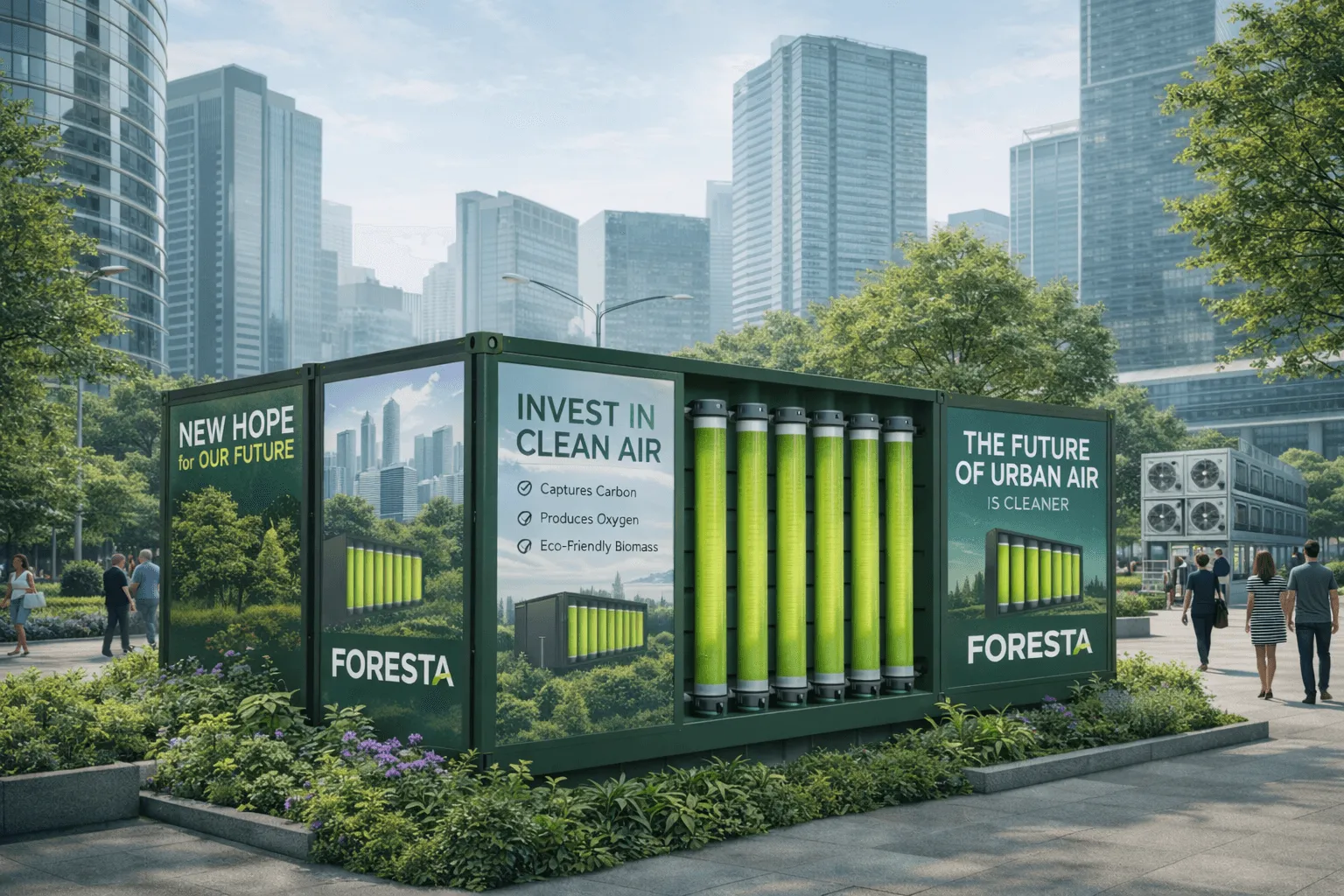
Physically present infrastructure breaks that pattern. A unit at a bus interchange or a school gate is something a resident encounters on the way to work. It is not more important than the enforcement regime. It is more legible than the enforcement regime, and legibility is what sustains funding.
This is the same logic that made rooftop solar politically powerful in India. Solar panels did not become popular because citizens understood the levelised cost of energy. They became popular because they are visible on a roof and they signal a decision that has been taken.
The interpretive layer
Where Smart Cities infrastructure and physical deployment combine well is in the interpretive layer between them — the thing that connects a unit on the ground to the data on the screen.
A deployment that reports into the ICCC can support:
- On-site display. A panel on the unit itself showing local capture and pollutant reduction, so the person standing next to it can see what it is doing.
- Ward-level dashboards that show interventions alongside readings, rather than readings alone.
- Before-and-after at fixed points, where a sensor pair at a deployment site gives residents a comparison they can understand.
- School and civic engagement, where a unit at an educational institution becomes a teaching object about photosynthesis, carbon and urban ecology.
Siting for visibility as well as effect
There is a real tension here, and it should be acknowledged rather than smoothed over. The location with the highest exposure reduction benefit is not always the location with the highest civic visibility.
A unit at an industrial estate boundary may deliver more measured reduction than one at a city square. The square delivers more public awareness.
The resolution is not to pick one. It is to be explicit about which objective each deployment serves, and to fund them from appropriate sources:
| Objective | Best siting | Funding route |
|---|---|---|
| Maximum exposure reduction | Traffic intersections, industrial boundaries, hospital and school frontages | Air quality grants, NCAP allocation |
| Civic visibility and trust | Public squares, transit hubs, municipal frontages | Smart Cities, advertising concession |
| Institutional benefit | Schools, hospitals, anganwadis | Corporate CSR under Section 135 |
A programme that mixes all three across a city, and reports each honestly against its own objective, is far more defensible than one that claims every unit is optimally sited for everything.
Advertising as the funding bridge
The most underused Indian mechanism here is the outdoor advertising concession.
Municipal bodies already tender advertising rights on bus shelters, foot-over-bridges, medians and hoardings. A capture unit configured with display panels is, from a tendering standpoint, ordinary street furniture with an unusual secondary function.
Structured that way, the deployment moves from the environment budget to the revenue side. The concessionaire has a commercial reason to keep the unit clean, powered and operating, which solves the maintenance problem that strands so much municipal environmental infrastructure. The city gets abatement and visibility without capital outlay.
A city that can show its residents a working piece of climate infrastructure on the walk to the metro has an easier conversation about air quality budgets than one that can only show them a number.
Conclusion
The Smart Cities Mission built India’s municipal capacity to see. The next phase has to build capacity to demonstrate response, and to make that response encounterable at street level rather than only legible on a dashboard.
Visible climate infrastructure is not a substitute for enforcement, fuel standards or modal shift — those remain the substance. But it converts abstract municipal effort into something a citizen can point at, and in a democracy that is not a cosmetic consideration. It is how the budget for the invisible work gets renewed.