
Technology
Microalgae vs Direct Air Capture: The India Deployment Case
Both pathways remove carbon. Their suitability diverges sharply once you apply Indian conditions — grid carbon intensity, land cost, storage geology and the absence of a CO₂ pipeline network.
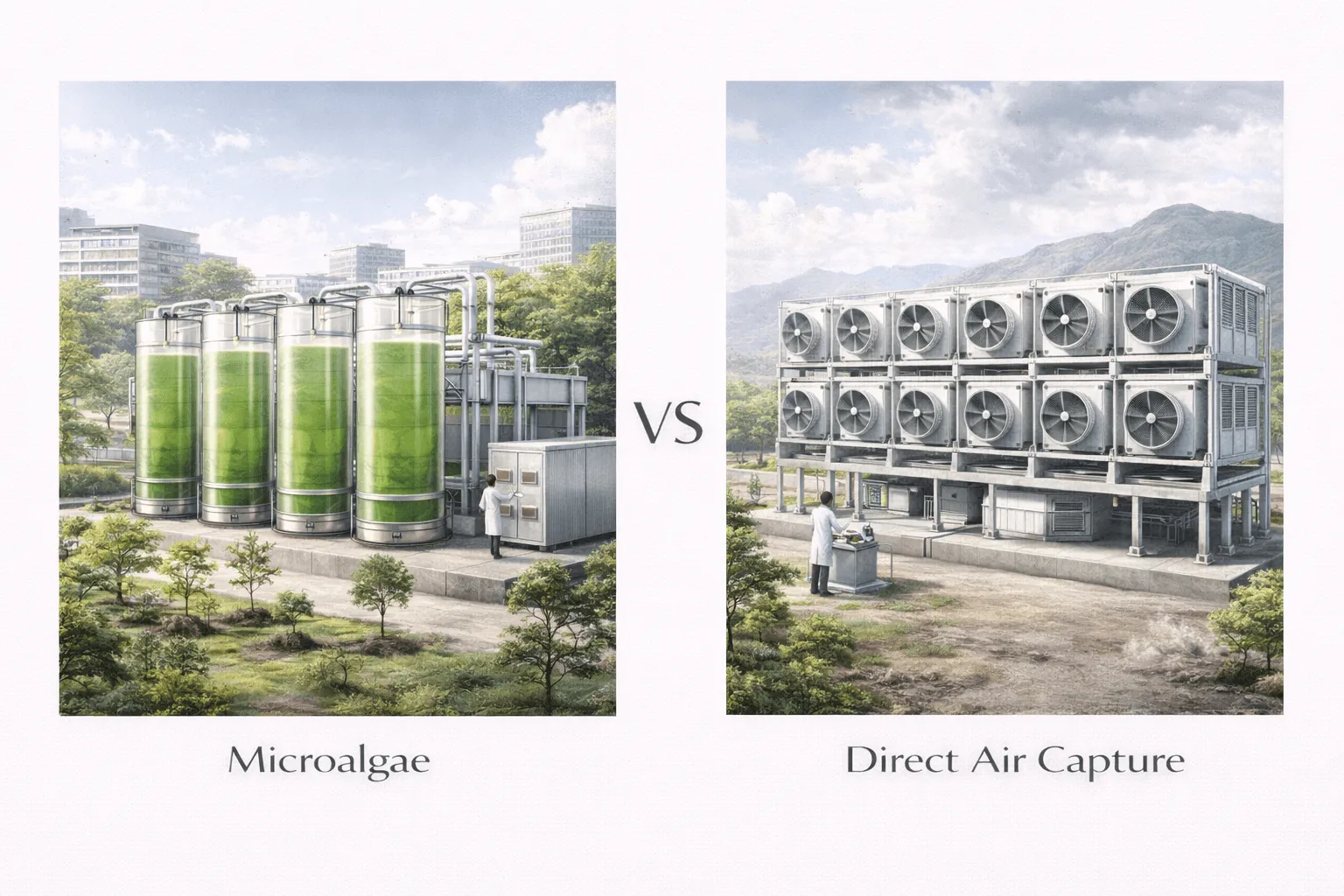
Carbon removal has moved from theory to procurement. Two technological families dominate the conversation: Direct Air Capture, which uses chemical sorbents to pull CO₂ from ambient air, and biological capture, which uses photosynthetic organisms — in engineered form, microalgae in photobioreactors.
Internationally, the comparison is usually framed around cost per tonne and permanence. Applied to India, a different set of variables dominates, and they push the answer in a direction that global commentary often misses.
The two approaches in brief
Direct Air Capture
DAC systems move large volumes of air across chemical sorbents that bind CO₂. The sorbent is then regenerated — typically with heat — releasing concentrated CO₂ that is compressed and either stored geologically or used industrially.
- Technology-driven and highly controllable
- Scalable at industrial scale
- Produces a concentrated, storable CO₂ stream
- Energy-intensive, particularly in the regeneration step
Microalgae photobioreactors
Microalgae absorb CO₂ through photosynthesis, growing rapidly under controlled light, temperature and nutrient conditions. Carbon is fixed into biomass, which is harvested on a cycle.
- Biological but engineered
- Modular and suited to distributed deployment
- Lower energy intensity per unit at urban scale
- Produces biomass rather than a concentrated CO₂ stream
Why the Indian context changes the ranking
Grid carbon intensity
DAC’s climate value depends entirely on the carbon intensity of the energy that runs it. Regeneration heat is the dominant load, and if that energy carries a high emissions factor, a meaningful share of the captured carbon is offset by the capture itself.
India’s grid has decarbonised substantially and continues to, but its average emissions factor remains well above that of the Nordic or Icelandic grids where flagship DAC plants have been sited. Running energy-intensive capture on a coal-heavy marginal grid is a materially different proposition from running it on Icelandic geothermal.
Photosynthesis, by contrast, is powered by sunlight. Pumps, circulation, monitoring and supplementary lighting draw power, but the capture mechanism itself does not require thermal regeneration.
Storage geology and transport
DAC produces concentrated CO₂ that has to go somewhere. In the United States and Europe, that means depleted hydrocarbon reservoirs and saline aquifers connected by developing CO₂ pipeline infrastructure.
India has identified potential storage basins, but there is at present no CO₂ transport network of consequence, and the regulatory framework for long-term geological storage liability is still developing. A DAC facility in an Indian city would capture into a logistics chain that does not yet exist.
Biological capture sidesteps this. The carbon leaves as biomass, on a truck, to an existing offtake — fertiliser, feed, biofuel feedstock, bioplastics. That supply chain is ordinary freight, not novel infrastructure.
Land and siting
DAC installations are industrial in footprint and character. Even modest pilots require substantial area for air contactors, regeneration units and compression. Siting them inside Indian urban cores is a zoning and land-cost problem before it is an engineering one.
Modular photobioreactors are designed for distributed placement — plazas, campuses, transit hubs, industrial estate boundaries. A CTRX at 14.4 m² is roughly a parking bay.
Permanence — the honest caveat
This is where the comparison runs the other way, and it should be stated plainly.
DAC with geological storage offers a clear permanence pathway: CO₂ injected into suitable formations stays there on geological timescales. Biological capture fixes carbon into biomass, and the permanence of that carbon depends entirely on what happens to the biomass next.
If algae biomass becomes biofuel, the carbon returns to the atmosphere on combustion — the benefit is displacement of fossil carbon, not removal. If it becomes fertiliser or feed, most of it cycles back within a season. Durable sequestration from biomass requires deliberate downstream choices such as biochar or material integration.
The co-benefit that decides it in India
There is one factor that dominates the Indian calculation and is largely absent from European and American analysis: particulate matter.
DAC targets CO₂. It is not designed to, and does not meaningfully, reduce PM2.5, PM10, NOx or SOx. Its climate benefit is real and its local air quality benefit is close to zero.
For an Indian city, CO₂ is a national commitment; PM2.5 is a daily emergency. Fourteen of the world’s twenty most polluted cities are Indian. The health burden that voters, courts and commissioners actually respond to is particulate, not carbon.
Microalgae photobioreactors reduce both. The air drawn through the system has its particulates and gaseous pollutants scrubbed alongside CO₂ absorption. That dual action means one asset addresses the national commitment and the local emergency at once.
Scaling models
| DAC | Microalgae | |
|---|---|---|
| Scaling logic | Larger centralised plants | More distributed modular units |
| Best siting | Industrial zones near cheap low-carbon energy and storage | Urban cores, campuses, industrial boundaries |
| Energy | High, thermal-dominated | Lower, light-dominated |
| Output | Concentrated CO₂ | Harvestable biomass |
| PM/NOx reduction | Negligible | Yes |
| Permanence | Strong with geological storage | Depends on biomass end use |
| India readiness | Constrained by storage and grid | Deployable today |
Conclusion
This is not a question of which technology is superior. DAC is an essential part of the global carbon removal portfolio and will matter enormously in regions with abundant low-carbon energy and viable storage geology.
The Indian question is narrower: which pathway can be deployed now, in the places where pollution exposure is highest, without requiring infrastructure the country has not yet built, and while addressing the particulate crisis that dominates domestic air policy.
On that question, distributed biological capture has the stronger case — provided its permanence claims stay honest and it is positioned as air quality and circular-value infrastructure rather than as a substitute for geological removal.