Policy
Why NCAP Targets Need Infrastructure, Not Just Monitoring
India has built one of the world’s densest air quality monitoring networks. Measurement is not abatement — and the gap between the two is where deployable carbon and particulate infrastructure now has to sit.

India’s National Clean Air Programme set out to cut particulate pollution in the country’s most affected cities, with a revised target of up to 40% reduction in PM concentrations by 2025–26 against a 2017 baseline. Under it, more than a hundred non-attainment cities have prepared city-specific clean air action plans, and thousands of crores have been released to municipal bodies to implement them.
The programme has achieved something genuinely difficult: it made air quality a measured, budgeted, politically visible subject. Continuous ambient air quality monitoring stations now report in near real time, and the daily AQI figure has entered ordinary public conversation in a way it had not a decade ago.
What it has not yet done, at the scale required, is close the distance between knowing the number and changing it.
Measurement is not abatement
A monitoring station tells you the concentration of PM2.5 outside a particular building at a particular hour. It does not remove a microgram of it. The implicit theory of change is that better data drives better decisions, which drive interventions, which eventually move the number.
That chain works when the interventions at the end of it are available, affordable and fast. In much of urban India, the interventions available to a municipal commissioner are:
- Road dust suppression — mechanical sweeping and water sprinkling
- Construction and demolition waste rules
- Transitioning municipal fleets and public transport
- Restrictions on open burning
- Greening and plantation drives
Every one of these is worth doing. But look at what they have in common: they are all either source-control measures dependent on enforcement across thousands of dispersed actors, or they are plantation measures that take fifteen to twenty-five years to reach meaningful sequestration capacity.
Neither category produces a measurable, attributable reduction inside the fiscal year in which the money is spent. That is an awkward position for an administrator who has to report progress annually against a target.
The land problem behind the plantation problem
The default answer to urban air quality in Indian planning documents is greening. Plant more trees, expand green cover, create urban forests. The Miyawaki method in particular has been widely adopted by municipal corporations from Mumbai to Chennai precisely because it promises faster canopy growth on small plots.
The constraint is not enthusiasm. It is land.
A mature tree’s sequestration capacity is real but modest, and delivering the equivalent of several hundred mature trees requires hectares of contiguous, protected, irrigated land in exactly the districts where land trades at rates that make such use economically impossible. Central Delhi, South Mumbai, Bengaluru’s central business district, the industrial belts of Gujarat and Tamil Nadu — these are the areas with the worst air and the least available ground.
Cities have responded by planting where land is available, which is generally the periphery. That is worth doing for biodiversity, heat and long-term canopy. It does comparatively little for the exposure of a person standing at a traffic intersection in the city core, because the pollution is concentrated where the plantation is not.
What a deployable system changes
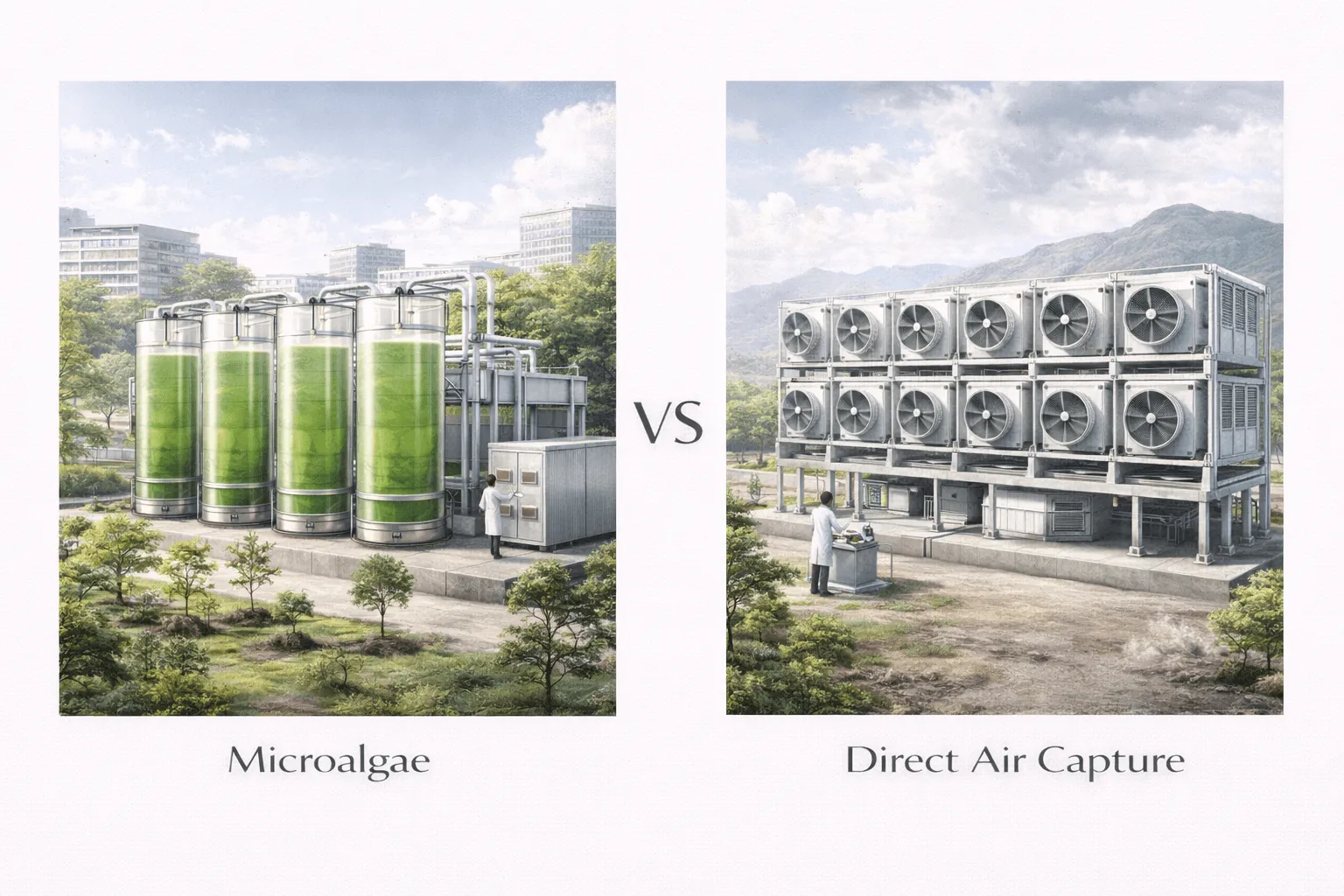
A modular photobioreactor changes the arithmetic in three specific ways, none of which is about replacing trees.
It decouples impact from land area. A containerised CTRX unit occupies 14.4 m² and delivers roughly 24,000 m² of forest-equivalent impact. The relevant comparison is not “tree versus machine” but “what fits in the space actually available at the location where exposure is highest”.
It compresses the timeline. A unit commissions in days. Its absorption on day thirty is its absorption at steady state. A sapling planted the same week reaches comparable capacity around 2050.
It produces attributable data. Because the system is a discrete, instrumented asset, capture can be logged per unit. For a city reporting against NCAP, this is the difference between “we planted 40,000 saplings” and “these eleven units removed this quantity over this period at these locations”.
Where this fits in a city action plan
A serious clean air strategy for an Indian city is layered, and engineered capture occupies a defined layer within it rather than substituting for the others.
| Layer | Instrument | Horizon |
|---|---|---|
| Source control | Fuel standards, industrial norms, C&D rules | Continuous, enforcement-dependent |
| Modal shift | Public transport, EV transition | 5–15 years |
| Green cover | Plantation, urban forests, Miyawaki | 15–25 years |
| Engineered capture | Modular photobioreactors, DAC | Days to commission |
| Measurement | CAAQMS network, low-cost sensors | Continuous |
Read that way, deployable systems are the layer that produces effect inside the reporting cycle while the slower, structurally more important layers mature. They buy time; they do not substitute for the transition.
Funding routes that already exist
The practical objection is usually budgetary rather than technical. Three existing routes are relevant, and none requires a new scheme:
- Fifteenth Finance Commission air quality grants, which are released to million-plus cities specifically against air quality outcomes and are already outcome-linked.
- Corporate CSR under Section 135, where environmental sustainability is an explicit Schedule VII activity and a physical, located, photographable asset is a considerably easier project to report than a diffuse programme.
- Advertising concessions, where a unit configured with display panels can be tendered as media infrastructure that happens to also abate, shifting the cost from the environment budget to the revenue side.
The third route is the one Indian cities are least accustomed to considering, and structurally the most interesting: it converts climate infrastructure from a cost centre into a concession that a private operator has reason to maintain.
The question for the next phase of NCAP is not whether India can measure its air. It demonstrably can. It is whether the interventions available to a commissioner in a non-attainment city can act on the same timescale as the reporting that judges them.
Conclusion
NCAP built the instrumentation layer, and it built it well. The programme’s next constraint is the abatement layer — specifically, the shortage of interventions that are deployable in dense urban cores, that produce effect within a budget cycle, and that generate attributable data rather than activity counts.
Engineered biological capture does not solve air quality. Source control does that. But it fills a gap that neither enforcement nor plantation can currently fill, in exactly the locations where exposure is highest and land is scarcest. For cities that have to show movement on a number they are already measuring accurately, that is not a marginal consideration.