
ESG
Turning CSR Spend into Measurable Climate Assets
Section 135 moves roughly ₹30,000 crore a year into mandated CSR. Environmental sustainability is an eligible activity — but most environmental CSR is hard to audit. Physical, located assets change that.
India is the only major economy with a statutory corporate social responsibility obligation. Section 135 of the Companies Act, 2013 requires qualifying companies — broadly, those crossing thresholds of net worth, turnover or net profit — to spend at least 2% of average net profits of the preceding three financial years on CSR activities listed in Schedule VII.
Since the 2021 amendments, the regime has tightened considerably. Unspent amounts must be transferred to specified funds or, for ongoing projects, to an Unspent CSR Account with a defined utilisation window. Impact assessment is mandatory for larger programmes. CSR-2 reporting obligations have expanded. The practical effect is that CSR has moved from a soft disclosure exercise to something closer to a regulated spending programme with audit exposure.
That shift changes what makes a good CSR project.
The auditability problem in environmental CSR
Schedule VII item (iv) covers ensuring environmental sustainability, ecological balance, conservation of natural resources and maintaining air, water and soil quality. It is one of the most-used categories.
It is also one of the hardest to evidence. Consider what a typical environmental CSR file contains:
- Photographs of a plantation drive
- A count of saplings planted
- Attendance and participation figures
- An awareness campaign reach estimate
Now consider what an impact assessment or a sharp-eyed auditor asks:
- How many of those saplings survived to year three?
- What was the measurable change in the environmental parameter you claim to have improved?
- Is the outcome attributable to your spend, or would it have happened anyway?
- Where is the asset now, and who maintains it?
Most environmental CSR struggles with all four. Not because the intent is poor, but because diffuse activities genuinely are hard to measure, and because the outcome arrives on a timescale far longer than the reporting cycle.
What a physical climate asset changes
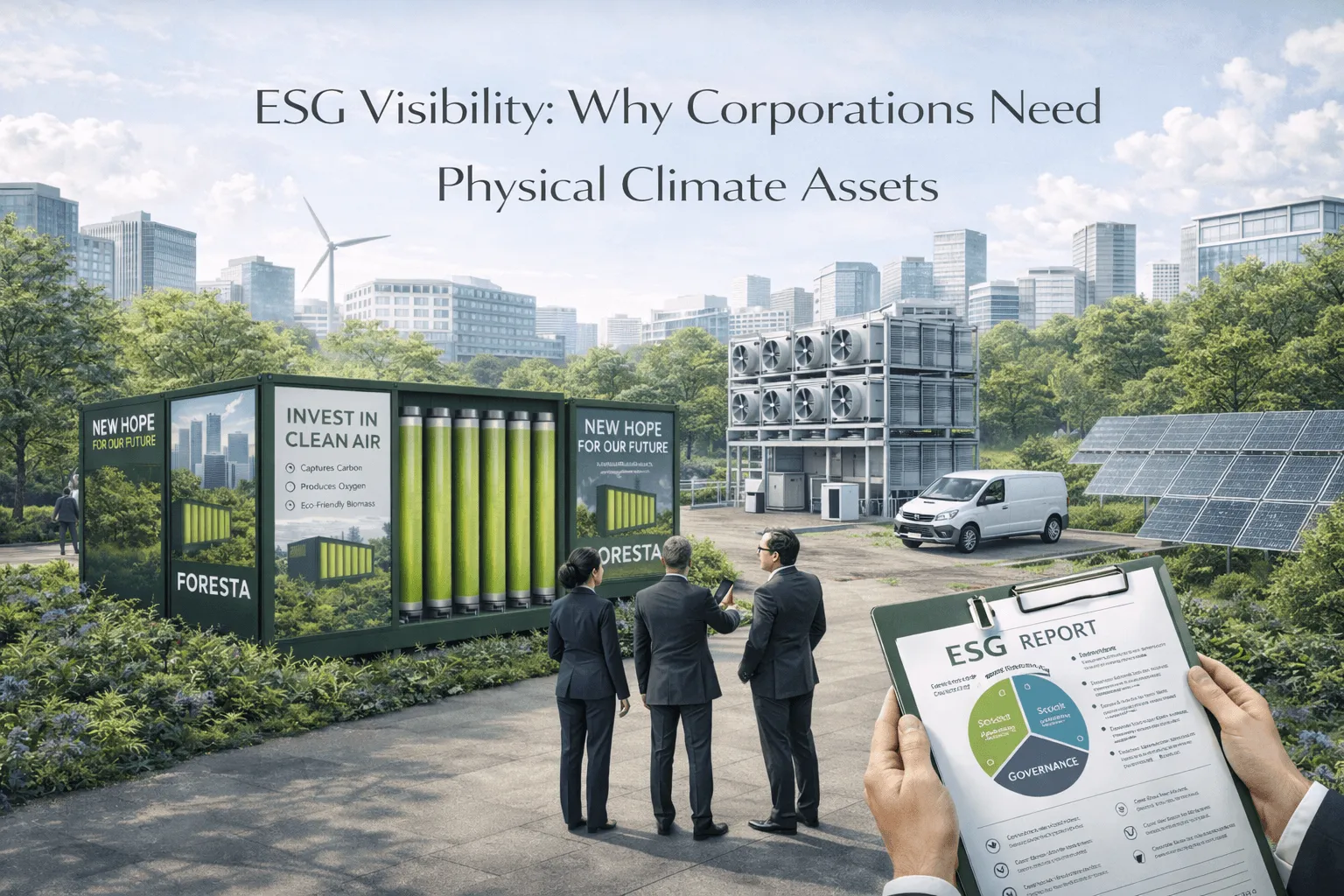
A deployed capture unit has properties that a programme does not.
It has a location. A latitude and longitude, a photograph, an address. An impact assessor can visit it. This sounds trivial; in practice, verifiability is what distinguishes a defensible file from a contested one.
It has instrumented output. Capture is logged. The claim is a measurement, not an estimate derived from a coefficient applied to an activity count.
It persists. A plantation drive is an event. A unit is an asset that continues operating across financial years, which suits the ongoing-project framework the amended rules contemplate.
It is attributable. Nobody else installed it. The counterfactual question — would this have happened anyway — has an obvious answer.
It is visible. For companies whose CSR sits alongside brand and stakeholder communication, a physical installation at a school, hospital or public plaza is legible to the community in a way that a grant transfer is not.
Where CSR-funded deployments make most sense
Not every siting is equally defensible. The strongest CSR cases share three features: a beneficiary community that is clearly not the company itself, a genuine exposure problem, and an institution capable of hosting the asset long-term.
- Government and municipal schools — high child exposure, clear public benefit, no ambiguity about who benefits
- Public hospitals and health centres — vulnerable populations, obvious health linkage
- Municipal public spaces — plazas, transit interchanges, markets in high-exposure districts
- Anganwadi and community centres in industrial belts
- Public university and college campuses
Structuring it properly
A few practical points that determine whether the spend survives scrutiny:
- Route it through an eligible implementing agency where required — a registered Section 8 company, trust or society with a valid CSR-1 registration, or the company’s own registered foundation.
- Treat it as an ongoing project if the commitment spans years, which brings the maintenance and service component inside the CSR envelope rather than stranding it.
- Budget the service contract, not just the unit. The commonest failure in Indian environmental CSR is capital spend with no operational provision. A unit without a maintenance agreement becomes a stranded asset within two years, and a stranded asset is worse for the file than no asset.
- Commission the impact assessment against instrumented data, so the assessor is verifying logs rather than reconstructing an estimate.
- Fix ownership and handover explicitly. Who owns the unit after the project period — the company, the implementing agency or the host institution? Write it down at the start.
The BRSR connection
For the top listed companies now filing Business Responsibility and Sustainability Reports, there is a second reason this matters. BRSR requires disclosure on emissions, energy and environmental initiatives under its principles, and reasonable assurance requirements have been progressively extended.
A CSR-funded physical asset with logged output feeds both files. The same instrumented data supports the CSR impact assessment and the BRSR environmental disclosure. That is a meaningful efficiency for teams currently assembling the two from different evidence bases.
The tightening of Section 135 is often read as a compliance burden. It can equally be read as an invitation: the regime now rewards exactly the kind of project that produces a located, measured, persistent asset — and penalises the kind that produces a photograph.
Conclusion
Roughly ₹30,000 crore a year flows through mandated Indian CSR, and a substantial share of it goes to environmental activity that is genuinely well-intentioned and genuinely difficult to evidence.
Physical climate infrastructure is not the only answer, and it will not suit every company’s CSR strategy. But for a company that wants its environmental spend to survive an impact assessment, feed its BRSR disclosure, and remain visible to the community it was meant to serve, an instrumented asset at a public institution is a materially stronger position than a plantation drive with a survival rate nobody measured.