Technology
The Indoor Air Problem in Indian Workplaces
Indian offices, schools and hospitals track outdoor PM2.5 far more closely than anyone assumes. The productivity and health cost is measurable — and filter-based fixes carry a recurring cost that scales badly.
Indian air quality discussion is almost entirely about outdoor concentrations. AQI readings, stubble burning, vehicular load, industrial emissions, construction dust. The implicit assumption is that indoors is a refuge.
For most Indian buildings, it is not.
Why indoor tracks outdoor in India
In sealed, mechanically ventilated buildings with good filtration — the North American and Northern European commercial norm — indoor particulate concentrations run well below outdoor. The building envelope does real work.
Indian building stock is different in ways that matter:
- Natural ventilation is the design default for a large share of the year, and for most of the building stock outside premium commercial real estate. Windows open, and outdoor air comes in unfiltered.
- Envelope leakage is high in older and mid-market construction.
- Filtration standards are modest. Where air handling exists, filter grades are frequently specified for equipment protection rather than occupant health.
- Indoor sources add to the load rather than replacing it — cooking, incense, mosquito coils, cleaning chemicals, printing.
The result is that indoor PM2.5 in Indian offices, schools and public buildings frequently correlates closely with outdoor readings, sometimes at 60–80% of ambient, and occasionally exceeds it when indoor sources are active.
The cost that shows up on the P&L
The health literature on particulate exposure is extensive and consistent — respiratory and cardiovascular effects are well established. Less discussed in Indian corporate settings is the cognitive and productivity literature.
Research on office environments has repeatedly found measurable decrements in cognitive function scores associated with elevated indoor CO₂ and particulate concentrations, with effects appearing in domains like information usage, strategy and crisis response. Studies of call centre and clerical productivity have found associations between ambient particulate levels and output.
For an employer, the relevant translation is:
- Sick leave and short-duration absence
- Presenteeism — attending while unwell and working at reduced capacity
- Cognitive performance decrement across the whole workforce, which is diffuse and rarely attributed to its cause
- Medical insurance claims experience
- Retention, particularly of senior staff with children and location choice
None of these appears in accounts as an air quality line. All of them are affected by it.
Why the filter economics scale badly
The standard institutional response is portable HEPA purifiers, or upgraded filtration in the AHU where one exists. Both work. Both have a cost structure that scales unpleasantly.
A HEPA purifier is cheap to buy and expensive to keep. Filters loaded with Indian ambient particulate concentrations reach saturation faster than manufacturer schedules based on cleaner-air markets assume. In heavily polluted cities, replacement intervals of a few months are common.
Across a large campus, the pattern is predictable: a capital purchase of several hundred units, an initial improvement, then a gradual decline as replacement budgets are not renewed and saturated filters are left in place. A saturated filter is not a neutral outcome — it is a resistance in the airflow doing very little.
The biological alternative
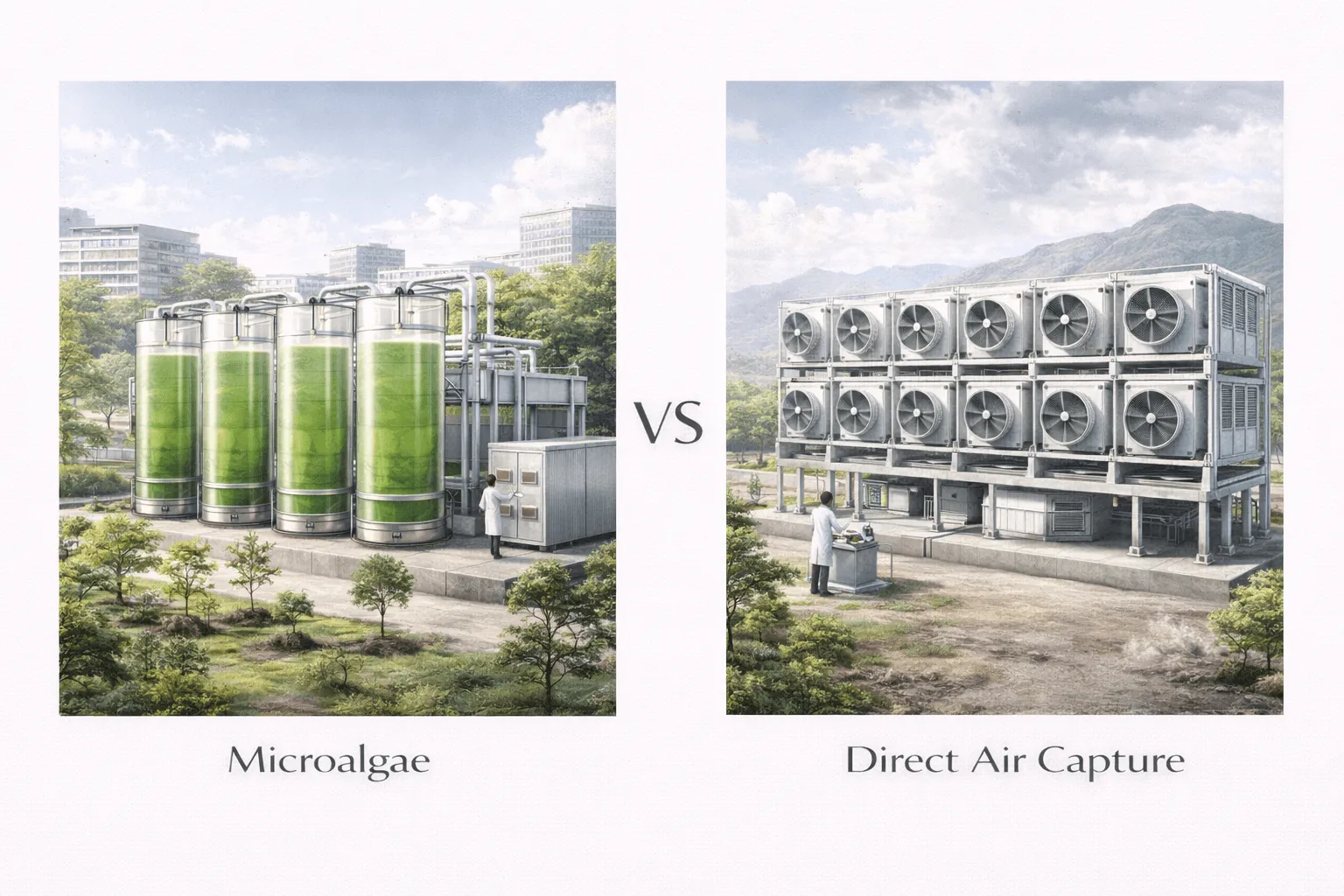
A photobioreactor addresses the same problem through a different mechanism. Air is drawn through a chamber where microalgae absorb CO₂ and where particulates and gaseous pollutants are captured in the aqueous medium rather than accumulating on a filter substrate.
The practical consequences for a facilities manager:
- No filter consumable. Maintenance is periodic biomass harvest and medium servicing rather than cartridge replacement.
- CO₂ as well as particulates. Indoor CO₂ concentration in occupied Indian meeting rooms routinely exceeds levels associated with cognitive decrement, and no HEPA filter addresses it.
- Oxygen enrichment as a direct output of photosynthesis.
- Visible function. In reception areas, campuses and schools, the unit is legible as an intervention in a way a white plastic box is not.
The honest limitations should be stated alongside: a Liquid Tube is rated at 2–3 mature-tree equivalence, which is a meaningful contribution to a room rather than a whole-building solution. Volume and layout determine unit count. It requires power and periodic servicing, and it is a larger physical object than a portable purifier.
Where the case is strongest
| Setting | Why |
|---|---|
| Schools and childcare | Children’s exposure risk is highest; reception and classroom siting also has teaching value |
| Hospitals and clinics | Vulnerable populations, long dwell times, existing air quality attention |
| Corporate reception and open-plan floors | High occupancy density, visible to staff and visitors, productivity linkage |
| Hotels and hospitality | Guest experience differentiation in high-AQI cities |
| Gyms and fitness centres | Elevated respiration rate multiplies exposure per unit concentration |
| Co-working and premium commercial | Tenant differentiator in a competitive leasing market |
Practical guidance
- Measure before you buy. Low-cost indoor monitors are inexpensive and will tell you whether you have a problem, where, and when. Most Indian facilities teams have never measured indoor PM2.5 at desk height.
- Prioritise by exposure-hours, not by seniority of occupant. The floor with two hundred people for nine hours matters more than the corner office.
- Budget the operating cost explicitly, whatever technology you choose. The failure mode of every indoor air programme in India is the second year.
- Address CO₂ and particulates as separate problems. They have different sources and different remedies, and a solution for one may do nothing for the other.
- Publish the data internally. Staff who can see the indoor reading trust the intervention; staff who cannot assume nothing is happening.
Indian employers spend considerable effort on the visible components of workplace wellbeing. The air people breathe for nine hours a day is among the least examined and most consequential.
Conclusion
Indoor air in Indian workplaces, schools and hospitals is substantially worse than institutional assumption allows, and the cost lands on health, cognition and retention rather than on any identifiable budget line.
Filter-based approaches work but carry a recurring consumable cost that Indian facilities budgets have repeatedly failed to sustain. A filter-free biological system changes that cost structure, adds CO₂ reduction that filtration does not address, and is visible to occupants as evidence that the problem is being taken seriously.
Neither approach removes the need to measure first. Any institution considering either should start with a fortnight of indoor monitoring at occupied desk height — the results are usually the argument.