Industry
Industrial Clusters and Distributed Carbon Capture in India
CEPI-flagged clusters concentrate emissions, people and regulatory risk in the same few square kilometres. Distributed capture at the boundary addresses a problem that stack controls structurally cannot.

Indian industry is clustered. Vapi, Ankleshwar, Vatva, Manali, Korba, Singrauli, Ghaziabad, Ludhiana, Tarapur — the Comprehensive Environmental Pollution Index identified a set of critically polluted areas whose defining feature is not any single large emitter but the aggregate load of many, in close proximity, often adjacent to dense residential settlement.
That geography creates a specific problem that conventional pollution control handles badly.
The boundary problem
Indian industrial environmental regulation is built around the stack and the outlet. Consent to Operate conditions specify emission concentrations at the point of release. Continuous Emission Monitoring Systems report at the stack. Enforcement action follows stack exceedance.
This framework works reasonably for the thing it was designed to control: a large point source with a measurable outlet.
It handles two things poorly.
Fugitive and diffuse emissions. Material handling, storage, transfer, loading, road dust from truck movement, evaporative losses. In many clusters these collectively rival or exceed stack emissions, and none of them has an outlet to monitor.
Cumulative ambient load. Every unit in a cluster can be individually compliant while ambient concentrations at the fenceline and in the adjacent settlement remain severely unhealthy. Compliance is assessed per-plant; exposure is experienced per-neighbourhood.
Why this is becoming a commercial risk
For a plant manager, this used to be a reputational matter. It is increasingly a financial one.
- NGT and High Court intervention. The National Green Tribunal has repeatedly ordered moratoria on new industrial approvals in critically polluted areas, restricted expansion, and imposed environmental compensation. A moratorium constrains growth for compliant and non-compliant units alike.
- Environmental compensation regimes have shifted from nominal to material, and are levied on ambient outcomes as well as consent breaches.
- Supply chain pressure. Multinational buyers with their own Scope 3 commitments now audit Indian suppliers on environmental performance. Losing an export customer over an environmental audit is a revenue event.
- BRSR value chain disclosure extends listed-company reporting into supplier environmental performance.
- Labour and community. Clusters with severe ambient pollution have measurable difficulty retaining skilled staff and face escalating community litigation.
The upshot is that ambient conditions at the cluster boundary, historically someone else’s problem, are becoming an operational risk for the individual plant.
Where distributed capture fits
None of this displaces the primary obligation. Process changes, better stack controls, fuel switching, leak detection and repair, and materials handling improvements remain the substance of industrial emissions reduction. A capture unit at the boundary is not an alternative to fixing a leaking process.
What it addresses is the residual — the diffuse, fugitive and cumulative load that stack controls structurally cannot reach.
Practical siting within a cluster:
- Fenceline, on the settlement-facing side. Where the plant boundary meets residential development, which is where exposure grievance and litigation originate.
- Material handling and loading yards. High fugitive dust, no outlet to control.
- Internal transport corridors. Truck movement in a large estate generates substantial resuspended particulate.
- Estate common areas. Where a cluster has an industrial association or estate authority, shared deployment at common boundaries spreads cost across members.
- Adjacent schools and health centres, funded through member companies’ CSR, which is both defensible under Schedule VII and directly responsive to community grievance.
The biomass angle
There is a second consideration specific to industrial settings that does not apply in a city plaza.
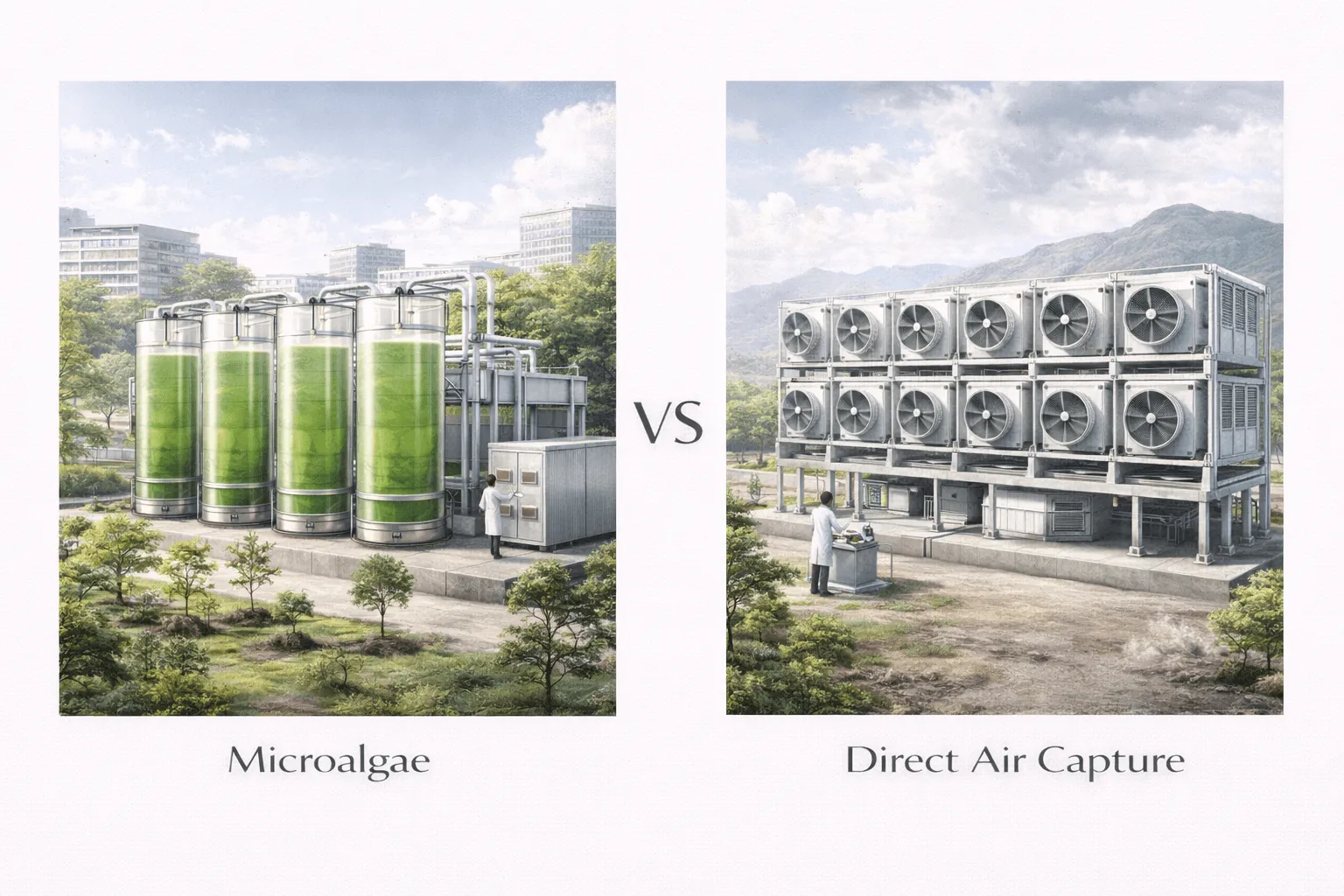
A capture system produces algae biomass on a harvest cycle. In an urban deployment this is a logistics question — someone collects it and takes it to an offtaker. In an industrial cluster, the offtaker may be inside the estate.
Depending on the cluster’s composition, harvested biomass can feed into:
- Fertiliser and soil conditioner production
- Animal and aquaculture feed
- Biofuel feedstock
- Bioplastic and biopolymer precursors
- Pigment and speciality chemical inputs
Chemical and agrochemical clusters in Gujarat, and food and feed processing in Maharashtra and Andhra Pradesh, have particularly obvious internal offtake. That converts a waste-handling cost into a small internal supply chain, and it means the environmental asset has a second reason to exist on the balance sheet.
What a realistic cluster programme looks like
- Establish an ambient baseline at the boundary, not just at the stack. Low-cost sensor networks make this affordable, and the baseline is what every later claim depends on.
- Identify the diffuse contribution. If stack compliance is good and ambient is poor, the gap is fugitive and cumulative. Quantify it before specifying anything.
- Fix what source control can fix. Sequencing matters. Deploying capture while a repairable process leak continues is spending money to mitigate something you could have stopped.
- Deploy at the exposure boundary for the residual, prioritising the settlement-facing side.
- Report ambient improvement, not unit count, and publish it locally. The community relations value depends on the data being shared.
- Structure offtake for the biomass before the first harvest, not after.
A plant that can demonstrate falling ambient concentrations at its own fenceline is in a materially different position before a regulator, a court, a buyer’s auditor and its neighbours than one that can only produce stack compliance certificates.
Conclusion
India’s industrial clusters face a tightening squeeze: cumulative ambient loads that individual compliance does not resolve, regulators and courts increasingly willing to restrict activity across whole areas, and buyers auditing environmental performance as a condition of trade.
Distributed capture at the boundary is a partial answer to a specific part of that problem — the diffuse and cumulative fraction that stack controls were never designed to address. Positioned as residual mitigation alongside serious source control, and structured through estate associations so the cost is shared where the benefit is, it addresses the exposure that generates the risk.