ESG
BRSR and the Rise of Verifiable Climate Infrastructure
As BRSR assurance tightens, estimated and modelled environmental claims get harder to defend. Instrumented physical assets produce the one thing an assurance provider can actually test.

The Business Responsibility and Sustainability Report changed Indian corporate environmental disclosure from a narrative exercise into a structured, comparable, increasingly assured one. Mandatory for the top listed companies by market capitalisation and expanding, BRSR requires quantitative disclosure across nine principles, with Principle 6 covering environmental performance in detail.
The direction of travel matters more than any single requirement. Reasonable assurance has been introduced for core indicators and the assured perimeter has widened. Value chain disclosure has entered the frame. What began as disclosure is becoming audited disclosure.
That progression has a specific consequence: the evidentiary bar for environmental claims is rising faster than most sustainability teams have restructured their evidence.
What assurance providers actually test
An assurance engagement does not evaluate whether your environmental strategy is good. It evaluates whether the numbers you published can be traced to something.
For energy and Scope 1 and 2 emissions, that tracing is usually straightforward: meter readings, fuel invoices, electricity bills, a published emission factor. The data exists because someone bills you for it.
For everything else — Scope 3, water stewardship, waste circularity, biodiversity, air quality initiatives — the trail is often much weaker. A provider asked to give assurance on “our green initiatives reduced emissions by X” will ask, in order:
- What is the source record for X?
- Who generated it, and are they independent of the claim?
- What methodology converted the record into the reported figure?
- Is the boundary of the claim consistent with the boundary of the record?
- Can the same figure be reproduced from the same records by someone else?
Estimated versus instrumented
The distinction that increasingly matters is not between good and bad initiatives. It is between claims backed by a meter and claims backed by an assumption.
Estimated claims take an activity count and multiply by a published coefficient. We planted 20,000 saplings; a mature tree sequesters roughly X kg per year; therefore we sequester 20,000X. Every step of that chain is contestable — survival rate, species, age, growing conditions, the coefficient’s applicability to Indian conditions.
Instrumented claims report what a device recorded. This unit, at this location, over this period, processed this volume and captured this quantity. The provider can test the device, the log, the calibration and the aggregation.
The second survives assurance. The first survives disclosure but not assurance, and the perimeter of assurance keeps expanding.
Why physical assets change the disclosure position
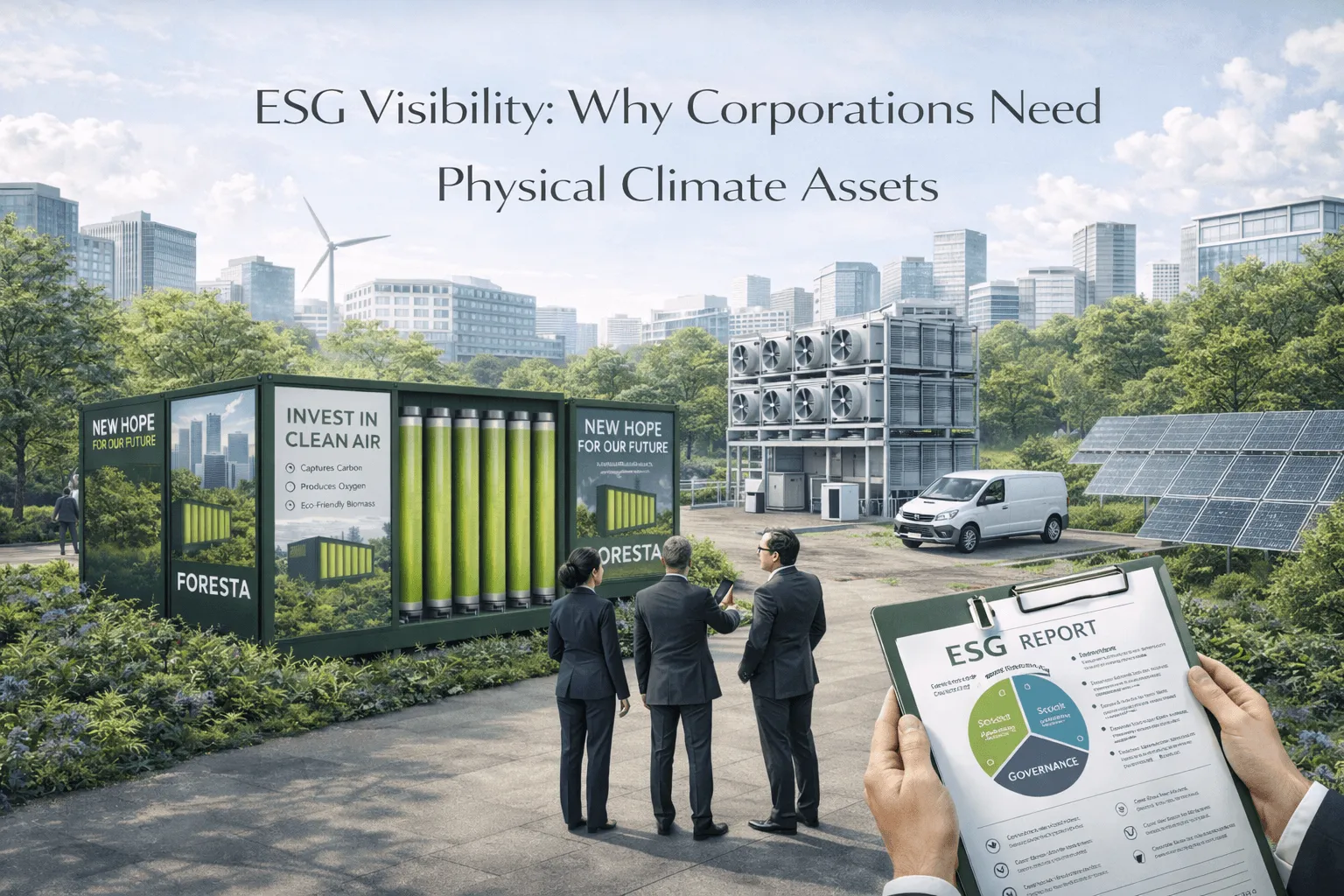
A deployed capture system is, from an assurance standpoint, unusually convenient:
- Discrete boundary. The asset is the boundary. There is no allocation question, no shared attribution, no double-counting risk with a partner.
- Continuous record. Output is logged rather than reconstructed at year end.
- Physical verification. The provider can visit it. Site verification is the cheapest form of assurance evidence and the most persuasive.
- Stable methodology. The conversion from operating data to reported figure does not change year to year, so comparatives hold.
- Ownership clarity. You bought it, you own it, you operate it. Contrast with a contribution to a multi-party programme.
Where this intersects with air quality
BRSR Principle 6 covers air emissions including NOx, SOx and particulate matter, alongside greenhouse gases. For Indian companies with manufacturing, logistics or large campus footprints, particulate disclosure is often the weaker half of the file — measured at the stack where regulation requires it, and essentially unaddressed at the ambient, boundary and community level.
A system that reduces both CO₂ and particulates produces evidence relevant to two separate disclosure lines from one asset. For companies whose operations sit in or near residential areas — which in Indian industrial geography is common — it also addresses the community relations dimension that Principle 4 and Principle 8 touch.
Practical guidance for sustainability teams
If you are preparing for expanded assurance, three moves are worth making regardless of technology choice:
- Audit your evidence base before your auditor does. For every quantitative environmental claim in last year’s BRSR, identify the source record. Anywhere the answer is “we applied a factor to an activity count”, flag it. That is your exposure list.
- Prefer instrumented interventions for new spend. Where two options deliver similar environmental outcome, the one that generates its own record is worth materially more in the file.
- Separate the aspiration from the assured number. Narrative about ambition belongs in the report and does not need assurance. Keep it clearly distinct from the quantitative claims that do, so an issue with one does not contaminate the other.
The companies that will find expanded BRSR assurance uncomfortable are not the ones doing least. They are the ones whose genuine effort has produced activity records rather than measurement records.
Conclusion
BRSR is converging on a simple standard: report what you can evidence. As assurance widens, the cost of an unverifiable claim rises from reputational to formal.
Physical, instrumented environmental infrastructure is not the only way to build a defensible file, and it is not a substitute for reducing emissions at source, which remains the substance of any credible strategy. But it produces exactly the kind of evidence the assurance process is built to test — a located asset, a continuous log, a stable methodology and a clear boundary.
For sustainability teams looking at where the next environmental rupee should go, that property is worth weighing alongside the environmental outcome itself.